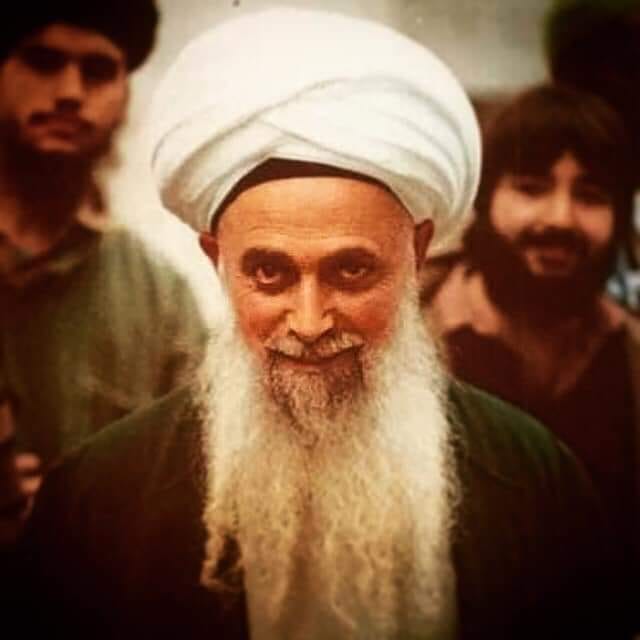

Abdul Khaliq al-Ghujdawani ق
The lights of some people precede their dhikr, while the dhikr of some people precede their lights. There is the one who does (loud) dhikr so that his heart be illumined; and there is the one whose heart has been illumined and he does (silent) dhikr.
— Ibn 'Ata'illah as-Sakandari
The Master of Miracles and Fountainhead of the Order
He was known as the Shaikh of Miracles, One Who Shone Like the Sun, and he was the Master of the high stations of spirituality of his time. He was a Perfect Knower (arif kamil) in sufism and accomplished in asceticism. He is considered the Fountainhead of this Honorable Sufi Order and the Wellspring of the Khwajagan (Masters of Central Asia).
His father was Shaikh 'Abdul Jamil, one of the most famous scholars in Byzantine times in both external and internal knowledge. His mother was a princess, the daughter of the king of Seljuk Anatolia.
Early Life and Education
Abdul Khaliq was born in Ghujdawan, a town near Bukhara in present-day Uzbekistan. There he lived and passed his life and was buried. He was a descendant of Imam Malik ؓ. In his childhood he studied the Qur'an and its tafsir (exegesis), 'ilm al-Hadith (the study of Prophetic Traditions), the sciences of the Arabic language, and Jurisprudence with Shaikh Sadruddin. After mastering Shari'a (the legal sciences) he moved on to jihad an-nafs (spiritual struggle), until he reached a high station of purity. He then moved to Damascus, where he established a school from which many students graduated. Each became a master of fiqh and hadith as well as spirituality, both in the regions of Central Asia as well as in the Middle East.
Meeting with Khidr ﷺ and the Discovery of Silent Dhikr
The author of the book al-Hada'iq al-Wardiyya tells us how he reached his high station within the Golden Chain:
"He met Khidr ﷺ and accompanied him. He took from him heavenly knowledge and added it to the spiritual knowledge he had obtained from his shaikh, Yusuf al-Hamadani.
"One day when he was reading the Qur'an in the presence of Shaikh Sadruddin, he came upon the following ayat: "Call unto your Sustainer humbly, and in the secrecy of your hearts. Verily, He loves not those who transgress the bounds of what is right" [7:55]. This ayat prompted him to inquire of Shaikh Sadruddin about the reality of silent Dhikr and its method. Abdul Khaliq put his question thus: "In loud dhikr you have to use your tongue and people might listen to you and see you, whereas in the silent dhikr of the heart Shaytan might listen to you and hear you, since the Prophet said in his holy hadith: 'Satan moves freely in the veins and arteries of the Sons of Adam.' What, then, O my Shaikh Sadruddin, is the reality of 'Call in the secrecy of your hearts?' His shaikh replied, 'O my son, this is a hidden, heavenly knowledge, and I wish that Allah Exalted and Almighty send you one of his saints to inspire on your tongue and in your heart the reality of secret dhikr.'
"From that time Shaikh Abdul Khaliq al-Ghujdawani waited for that prayer to be fulfilled. One day he met Khidr who told him, 'Now, my son, I have permission from the Prophet to inspire on your tongue and in your heart the hidden dhikr with its numbers.' He ordered him to submerge himself under water and to begin making dhikr in his heart (LA ILAHA ILLALLAH MUHAMMADUN RASUL ALLAH). He did this form of dhikr every day, until the Light of the Divine, the Wisdom of the Divine, the Love of the Divine and the Attraction of the Divine were opened to his heart. Because of those gifts people began to be drawn to Abdul Khaliq and sought to follow in his footsteps, and he took them to follow in the footsteps of the Prophet.
He was the first one in this honorable Sufi Order to use the Silent Dhikr and he was considered the master of that form of Dhikr. When his spiritual shaikh, al-Ghawth ar-Rabbani, Yusuf al-Hamadani, came to Bukhara, he spent his time in serving him. He said about him, 'When I became 22 years of age, Shaikh Yusuf al-Hamadani ordered Khidr to keep raising me and to keep an eye on me until my death.'
Miraculous Journey to Makkah
Grandshaykh Sharafuddin ad-Daghestani, the thirty-eighth shaykh of the Golden Chain, related a remarkable story:
"There was an event that happened on the night known as Laylat al-Raghaib, the Night of Desires, which takes place on the evening of the first Thursday of the Islamic month of Rajab. That day the mother of Abd al-Khaliq al-Ghujdawani had to do her laundry at the bank of the river. She took her son and was looking after him very well because her son was playing on the side of the river bank. Suddenly, she saw a man standing there, speaking with her son. She did not know who the man was, although he was making her son laugh, entertaining him. Then suddenly she looked and they had both disappeared.
She became frantic, searching along the river bank for her son, but he was gone. She began to cry. At that moment, she saw a pious man coming towards her. He said, "Why are you crying?" She said, "My only child, my son, on account of whom I saw many miracles in my life, has now disappeared, and I don't know what happened to him." He said to her, "Why are you worried? Do you not know that God takes care of pious people? If you are patient you will derive a lot of goodness. Where you are (your spiritual station) no one can become frustrated."
She asked, "Who are you?" He said, "I am the Prophet Elijah (Ilyas)." She said, "May God have mercy on you and us; again, who are you?" He replied, "God prohibited the earth to eat the flesh of the prophets. We are alive, not dead. We can move about where we like."
He said, "This is the night of the sixth of Rajab—the night in which good desires come. On that night, God sends on the Nation such mercy that angels of seven heavens are carrying, blessings on human beings so numerous that no one can count them other than God."
On that night the pure atom of the Prophet ﷺ passed from his father to his mother's womb. On that night, God orders all angels, all prophets and all saints to meet in the House of God. They meet in that place in order to get the blessings of the Prophet ﷺ. Your son, although he is still young, is one of the great saints of his time. Khidr ﷺ is who you saw speaking to him, and he took him and carried him to Makkah. From Merv to Makkah he was transferred in the blink of an eye. There he is going to see all these prophets, angels, and saints and he is going to inherit his share of sainthood from them. Be happy.
Then Sayyidina Abd al-Khaliq al-Ghujdawani was carried by Khidr ﷺ, and he was given in turn from one saint to another, and after that from one prophet to another until he reached the presence of the Prophet Muhammad ﷺ. Each saint was building up his spirituality, building up the light of his heart until he was prepared to meet the Prophet ﷺ.
Then the Prophet ﷺ hugged him in his arms and ordered all the spirits of the Companions ؓ to come forth. As soon as they appeared, the child was carried from one to another, one to another, until he reached the hands of Malik bin Sinan al-Ansari ؓ, who carried him to Prophet Muhammad ﷺ. The Prophet ﷺ said, "We are very happy and honored that this son is from our descendants."
The Ka'bah Visits the Master
One year when Sayyidina 'Abdul Khaliq al-Ghujdawani didn't go for Hajj as there were important issues in Merv, while pilgrims were on Hajj, the Ka'bah came, and at that moment Sayyidina 'Abdul Khaliq al-Ghujdawani ق said in his lecture, "The Ka'bah is here and I am making tawaf around Ka'bah."
The Ka'bah visited him! That story has been authenticated by many Naqshbandi Shaykhs. And the Ka'bah visits many Awliyaullah, and it visited him and left its door to show, "I visited Khawaja 'Abdul Khaliq al-Ghujdawani ق and left my door." When the hujjaj came back, they confirmed that the door of Ka'bah was not there and so it was left in Merv.
The Eleven Principles of the Naqshbandi Way
'Abdul Khaliq al-Ghujdawani coined the following phrases which are now considered the principles of the Naqshbandi Sufi Order:
#### 1. Conscious Breathing ("Hosh dar dam")
Hosh means "mind." Dar means "in." Dam means "breath." It means, according to Abdul Khaliq al-Ghujdawani ق, that the wise seeker must safeguard his breath from heedlessness, coming in and going out, thereby keeping his heart always in the Divine Presence; and he must revive his breath with worship and servitude and dispatch this worship to His Lord full of life, for every breath which is inhaled and exhaled with Presence is alive and connected with the Divine Presence. Every breath inhaled and exhaled with heedlessness is dead, disconnected from the Divine Presence.
#### 2. Watch Your Step ("Nazar bar qadam")
It means that the seeker while walking must keep his eyes on his feet. Wherever he is about to place his feet, his eyes must be there. He is not allowed to send cast his glance here or there, to look right or left or in front of him, because unnecessary sights will veil the heart. Most veils on the heart are created by the pictures which are transmitted from your eyes to your mind during your daily living.
#### 3. Journey Homeward ("safar dar watan")
It means to travel to one's homeland. It means that the seeker travels from the world of creation to the world of the Creator. It is related that the Prophet said, "I am going to my Lord from one state to a better state and from one station to a higher station." It is said that the seeker must travel from the Desire for the forbidden to the Desire for the Divine Presence.
#### 4. Solitude in the Crowd ("khalwat dar anjuman")
"Khalwat" means seclusion. It means to be outwardly with people while remaining inwardly with God. There are also two categories of seclusion. The first is external seclusion and the second is internal seclusion.
#### 5. Essential Remembrance ("yad kard")
The meaning of 'Yad' is Dhikr. The meaning of 'kard' is the essence of Dhikr. The seeker must make Dhikr by negation and affirmation on his tongue until he reaches the state of the contemplation of his heart (muraqaba). That state will be achieved by reciting every day the negation (LA ILAHA) and affirmation (ILLALLAH) on the tongue, between 5,000 and 10,000 times, removing from his heart the elements that tarnish and rust it.
#### 6. Returning ("baz gasht")
This is a state in which the seeker, who makes Dhikr by negation and affirmation, comes to understand the Holy Prophet's phrase, ilahi anta maqsusdi wa ridaka matlubi ("O my God, You are my Goal and Your Good Pleasure is my Aim.") The recitation of this phrase will increase in the seeker the awareness of the Oneness of God, until he reaches the state in which the existence of all creation vanishes from his eyes.
#### 7. Attentiveness ("nigah dasht")
"Nigah" means sight. It means that the seeker must watch his heart and safeguard it by preventing bad thoughts from entering. Bad inclinations keep the heart from joining with the Divine. It is acknowledged in the Naqshbandiyya that for a seeker to safeguard his heart from bad inclinations for fifteen minutes is a great achievement.
#### 8. Recollection ("yada dasht")
It means that the reciter of Dhikr safeguards his heart with negation and affirmation in every breath without leaving the Presence of Allah Almighty and Exalted. It requires the seeker to keep his heart in Allah's Divine Presence continuously. This allows him to realize and manifest the Light of the Unique Essence (anwar adh-dhat al-Ahadiyya) of God.
Guidance to His Followers
He gathered around him the loyal and sincere murids that he was training and teaching. In this regard, he wrote a letter to his son, al-Qalb al-Mubarak Shaykh Awliya al-Kabir, to specify the conduct of followers of this Order. It says:
O my son, I urge you to acquire knowledge and righteous conduct and the fear of Allah. Follow the steps of the pious Salaf (early generation). Hold fast to the Sunnah of the Prophet, and keep company with sincere believers. Read jurisprudence and life-history of the Prophet and Quranic exegesis. Avoid ignorant charlatans, and keep the prayer in congregation. Beware of fame and its danger. Be among the ordinary people and do not seek positions. Don't enter into friendship with kings and their children nor with the innovators. Keep silent, don't eat excessively and don't sleep excessively. Run away from people as you would run from lions. Keep seclusion. Eat lawful food and leave doubtful actions except in dire necessity. Keep away from love of the lower world because it might fascinate you. Don't laugh too much, because too much laughter will be the death of the heart. Don't humiliate anyone. Don't praise yourself. Don't argue with people. Don't ask anyone except Allah. Don't ask anyone to serve you. Serve your shaikhs with your money and power and don't criticize their actions. Anyone who criticizes them will not be safe, because he doesn't understand them. Make your deeds sincere by intending them only for Allah. Pray to Him with humbleness. Make your business jurisprudence, your mosque your house, and your Friend your Lord.
His Miracles
There is a renowned water well at his tomb in Uzbekistan, and it is commonly believed that if one drinks from that well, he will be cured of illness. If you visit it today, you will find that hundreds of people are visiting that tomb and the well, which has only one cup from which to drink, although none of the visitors get contaminated from the other, and many are cured.
Death and Succession
'Abdul Khaliq al-Ghujdawani had four khalifs. The first was Shaikh Ahmad as-Siddiq, originally from Bukhara. The second was Kabir al-Awliya ("the Greatest of Saints"), Shaikh 'Arif Awliya al-Kabir ق. Originally from Bukhara, he was a great scholar in both external and internal Sciences. The third khalif was Shaikh Sulaiman al-Kirmani ق. The fourth khalif was 'Arif ar-Riwakri ق. It is to this fourth khalif that Abdul Khaliq ق passed the Secret of the Golden Chain before he died on the 12th of Rabi'ul-Awwal 575 H/1179 CE.